
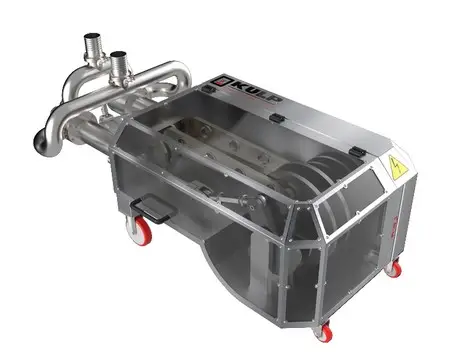
PV100 TRANSFER PUMP
TRANSFER OF DENSE, VISCOUS, AND PARTICULATE PRODUCTS CAPACITY: 3500 LT/HOUR
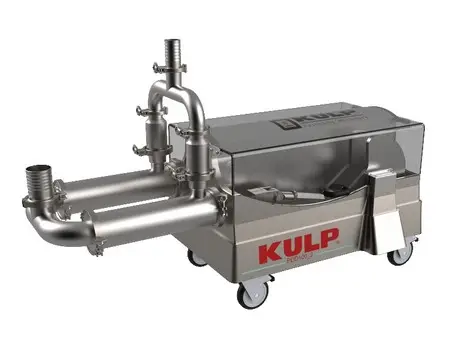
PD100 TRANSFER PUMP
TRANSFER OF LIQUID AND PARTICULATE PRODUCTS CAPACITY: 3500 LT/HOUR ADAPTABLE
Transfer Pumps
Transfer Pumps: The “Intravenous Line” of Production and Architects of Uninterrupted Flow
When you watch a production facility from the outside, you only see the flashy machines that do the filling and capping. But when you step into the “kitchen” of the operation, there is a completely different struggle in the background: How will we move tons of raw materials from point A to point B?
If your operators are still carrying buckets, climbing ladders, and trying to pour product into the hopper of the filling machine, let’s stop right here. This method is not just old-fashioned; it is also dangerous, slow, and full of hygiene risks.
At Kulp Makine, we view transfer pumps as the “intravenous line” of a factory. No matter how powerful the heart (filling machine) is, if the veins (pumps) carrying blood (product) to it are inadequate, the system collapses.
We want to tell you about the world of Sanitary Transfer Pumps—which are not just liquid transport tools, but also systems that protect your production quality, increase occupational safety, and end the “bucket-carrying ordeal.”
Why Manual Transfer is No Longer “Sustainable”
Picture that classic scene on the production floor: a large barrel sitting on the ground, and a staff member trying to scoop out raw materials with a pitcher or a bucket. Then, the risk of losing balance while trying to climb onto the filling machine with that heavy bucket…
The cost of this is greater than you think:
Occupational Safety Risk: Herniated discs, slips and falls, chemical splashes… The cost of a single work accident is higher than the most expensive pump.
Hygiene Violation: When the bucket lid is opened, the product comes into contact with air. Dust enters, hair falls in. The “closed-circuit” production chain is broken.
Product Waste: Every gram of product spilled, dripped on the floor, or left at the bottom of the bucket is money thrown away.
Time Loss: When the machine hopper is empty, it takes time for the operator to notice and refill it. The machine runs idle while “waiting for product.”
An automatic transfer pump eliminates all these risks with a single touch.
Kulp Makine Difference: Which Pump is Right for You?
“Let’s buy a pump; it should draw both water and honey.” Unfortunately, the laws of physics do not work that way. Your product’s consistency (viscosity), the particles within it, and its heat sensitivity determine the pump selection. Choosing the wrong pump can ruin the structure of your product (such as yogurt becoming watery or strawberries in jam being crushed).
At Kulp Makine, we select the pump most suitable for your product’s DNA:
1. Air-Operated Diaphragm Pumps
These are the “jokers” of the production world. They operate with pressurized air instead of electricity.
Advantage: There is no risk of sparking (Ex-Proof), making them number one for transferring alcohol, cologne, or flammable chemicals.
Field of Use: Fluid or medium-viscosity products like shampoo, liquid soap, water, and fruit juice.
2. Lobe Pumps – Food Friendly
If your product is “alive” or sensitive, lobe pumps come into play. These pumps transport the product gently without crushing it.
Advantage: The internal rotating lobes do not touch each other. This ensures that the pieces in strawberry jam, the aroma in olive oil, or the consistency of yogurt reach the machine without being spoiled.
Field of Use: Honey, jam, tahini, mayonnaise, cream cheese, yogurt.
3. Peristaltic and Gear Pumps
These are preferred for highly precise dosing or non-abrasive oily products.
The Beauty of Automation: Sensors Are Talking
Do not think of a transfer pump merely as a device with an “on-off” switch. In Kulp Makine systems, pumps “chat” with the filling machine.
How? We install a Level Sensor in the hopper of the filling machine.
When the product in the hopper decreases, the sensor sends a “Send me product!” signal to the pump. The pump starts automatically.
When the hopper is full, the sensor says “Okay, I’m full.” The pump stops automatically.
The result: No overflows, no machine downtime due to running out of product. Instead of carrying buckets, your operator supervises the quality of production.
Hygiene and Cleaning: The 316L Stainless Assurance
Transfer pumps are the areas where the product takes its longest journey. The inside of the pipes, the body of the pump… if bacteria nest here, the entire batch of product becomes waste.
The pumps supplied and integrated into systems by Kulp Makine are of Sanitary Grade standards.
Material: Parts in contact with the product are 316L stainless steel or certified food-compatible plastics.
Easy Cleaning (CIP Compatibility): Many of our pumps are Clean-In-Place (CIP) capable, meaning they can be washed in situ without disassembly. They are cleaned within minutes by circulating hot water or cleaning solutions.
Carry Your Product Without “Tiring” It
Some of our customers come to us with this complaint: “My cream in the tank is great, but when it gets into the bottle, it becomes watery; its consistency is ruined.” The culprit is usually an incorrectly chosen pump that shears the product at high speeds (shear stress).
We select technologies that treat your product “like a baby.” Our low-speed, high-torque pumps perform the transfer without disrupting the emulsion structure of your cream or breaking the crystal structure of your honey. Whatever the product is in the tank, it remains the same in the bottle.
The Human Touch: Your Operator Will Thank You
As a business owner, you look at the efficiency chart. But then there are the realities on the ground. It is impossible for an employee who lifts a 20-kg bucket 50 times a day to be efficient in the evening hours. Moreover, there are back pains and days off on medical leave…
Investing in a transfer pump is actually an investment in employee satisfaction. When you take that heavy physical load off your employees, you will see that they focus more on their work and error rates drop.
Conclusion: Accelerate the Flow, Zero Out the Risks
A production line is only as fast as its slowest link. If your filling machine can process 5,000 bottles per hour but your product feeding cannot keep up, the speed of that machine becomes meaningless.
With Kulp Makine’s transfer pump solutions:
Perform closed-circuit hygienic production.
End product waste and spills.
Eliminate the risk of work accidents.
Protect the structure of your product.
Let us examine your factory’s needs on-site. Let’s determine with our engineers which pipe diameter, pump type, and power you need. Keep your “veins” open and let your production flow healthily.
Frequently Asked Questions (FAQ)
1. Are the pumps self-priming? Or should I place them under the tank?
Many of our pumps (especially diaphragm and some lobe models) have “self-priming” capabilities. This means the pump can draw the product by creating a vacuum, even if it is located above the tank level. However, for very thick (paste-like) products, placing the pump under the tank (positive suction) increases efficiency.
2. I have a product with whole strawberries or peanut pieces; will the pump crush them?
If you use a standard centrifugal pump, yes, it will crush them and turn them into a puree. However, the Lobe Pumps recommended by Kulp Makine are designed for particulate products. The pieces are carried in the gaps between the lobes and reach the machine without being crushed.
3. Will the pump break if it runs dry (if the product in the tank runs out)?
This depends on the type of pump. Air-operated diaphragm pumps are resistant to running dry and will not break. However, some electric pumps with mechanical seals may overheat and be damaged if they run dry. This is why using a Level Sensor is a lifesaver; it automatically stops the pump when the product runs out.
4. Can I transfer hot products (80-90°C)?
Yes. The seals (diaphragms, o-rings) inside our pumps are selected from heat-resistant materials (Teflon, Viton, EPDM). You can safely transfer hot jam, hot chocolate, or pasteurized products.
5. How long does cleaning take?
If you choose a CIP (Clean-In-Place) compatible pump, you can clean it in 15-20 minutes by circulating cleaning fluid without needing to disassemble it. In models that require disassembly, it is very practical to disassemble and wash by hand without using tools, thanks to “Tri-Clamp” connections.