
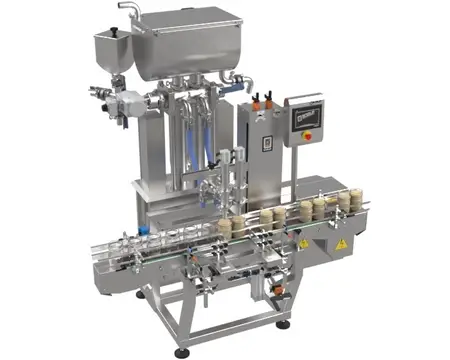
2-HEAD FILLING MACHINE
Volumetric filling system. Designed for liquid, semi-liquid, viscous, and solid
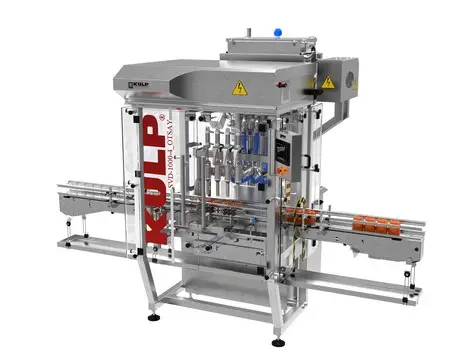
4-HEAD FILLING MACHINE
Servo motor or pneumatic control system and diving nozzles. Designed
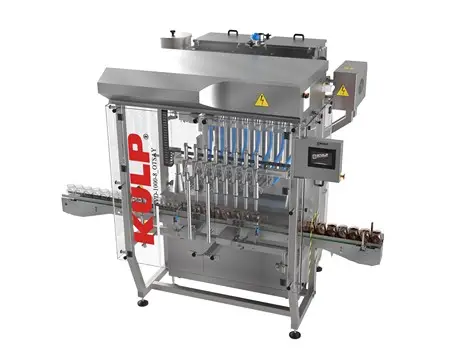
6-HEAD FILLING MACHINE
Servo motor control system and diving nozzles. Designed for liquid,
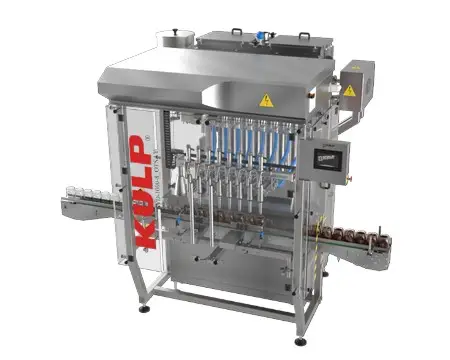
8-HEAD FILLING MACHINE
Servo motor control system and diving nozzles. Designed for liquid,
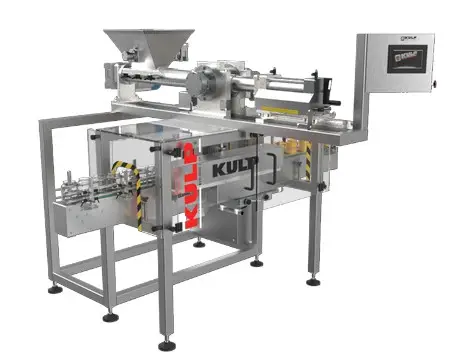
PUREE AND PASTE FILLING MACHINE
Filling with volumetric and auger systems. Designed specifically for high-viscosity
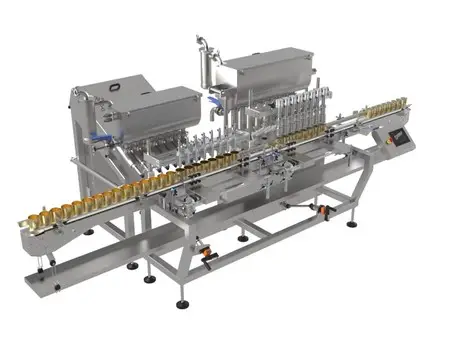
DUAL PRODUCT FILLING MACHINE
Fills two different products into a single container at a
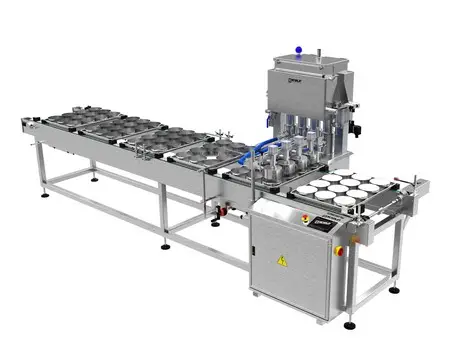
PASTRY FILLING MACHINE
Designed specifically for cake batter, sauces, creams, and similar products.
Automatic Filling Machines
Automatic Filling Lines: The Key to Speed, Quality, and Maximum Efficiency in Production
As a business owner or production manager, you have undoubtedly experienced that sweet but stressful moment: orders are increasing, the phones won’t stop ringing, customers want products, but your production area is signaling an alarm like a “clogged” artery. Your semi-automatic machines or manual processes can no longer keep up with this pace. Staff are exhausted, error rates are rising, and at the end of the day, the targeted production numbers are not met.
This is a moment of decision. You will either say “that’s just how it is” and stop growing, or you will meet Full Automatic Filling Lines that manage your production like a symphony orchestra.
At Kulp Makine, we do not view automation merely as “mechanization.” To us, a fully automatic line is a strategic partner that saves your business time, reduces costs, and standardizes your brand’s quality in every single bottle. So, what do these lines promise you? Let’s build the future of your factory together.
What is an Automatic Filling Line? (More Than Just a Machine)
An automatic filling line is not a standalone device; it is an ecosystem that communicates and works in synchronization. This system manages the entire process untouched by human hands, from the moment an empty bottle enters the line until it is cleaned, filled, capped, labeled, and made ready for casing.
You can compare this to a row of dominoes. Each unit (filling, capping, labeling) triggers the next. The bottle does not stop, does not wait, and does not pile up. It simply flows. This fluidity offers you a production capacity you couldn’t even imagine with manual methods.
Why Should You Switch to Full Automation?
Many manufacturers struggle with the question, “Is it worth the investment cost?” However, the real question is: “Can you afford the cost of NOT switching to automation?”
1. Increase in Speed and Capacity
If you are producing 3,000 products a day in a manual or semi-automatic system, this figure can rise to 20,000 or 50,000 on a fully automatic line. Moreover, the machine does not get tired, does not take breaks, and doesn’t call in sick. It can work at the same tempo 24/7.
2. Standard Quality and Brand Image
Look at your products lined up on a market shelf. If the liquid level in one bottle is 2 mm lower than another, or if a label is applied slightly crooked, the customer won’t buy that product. Automatic lines work with millimetric precision.
The same weight in every bottle.
The same cap tightness in every bottle.
The same label position on every bottle. This is the “We are professionals” message you give to your customer.
3. Hygiene and Safety (The 316L Assurance)
Especially in the food, pharmaceutical, and cosmetic sectors, human contact is the biggest risk factor. Kulp Makine’s fully automatic lines process the product in closed-circuit systems. By using 316L Stainless Steel on all contact surfaces, we eliminate the risk of corrosion and bacteria. Human hands only intervene when placing raw materials and taking the finished product; the process in between is completely sterile.
Anatomy of a Line: How Parts Integrate
The lines we establish at Kulp Makine have a modular structure. Shaped according to your needs, the building blocks of this structure are:
Bottle Feeding (Unscrambler / Rotary Table): Everything starts here. Even if bottles arrive in a jumble, the system aligns them and lines them up on the conveyor like soldiers in a single file. It is the first step in turning chaos into order.
Cleaning and Filling Group: This is the heart of the line. Bottles are first cleaned with air (air rinsing) and then filled using volumetric systems. Thanks to Kulp Makine’s smart sensors (“No Bottle, No Fill” feature), product waste is prevented.
Cap Feeding and Capping: This is perhaps the most challenging stage because there are hundreds of types of caps (screw, snap-on, spray, pump). The automatic system aligns the cap, places it on the bottle mouth, and tightens it with torque-adjusted heads. It’s never too loose to leak, nor too tight to be unopenable. Just right.
Labeling: This is your product’s identity. Single-side, double-side, or wrap-around labeling is performed on cylindrical, flat, or angular bottles, ensuring a smooth finish without bubbles.
Collection: The final scene. Ready products are collected on a rotary table and presented to the packaging personnel.
Kulp Makine Difference: “Tailor-Made” Engineering
You can find standard lines on the market sold as “off-the-shelf” packages. However, every factory’s space, every product’s viscosity, and every bottle’s form is different. At Kulp Makine, we offer tailor-made solutions.
Flexibility: When setting up our line, we take your future growth plans into account. If you say “I am filling 500 ml today, but I might switch to 1 liter tomorrow,” we design your machine to be compatible with that through tool-free adjustment.
User-Friendly Technology: The touch PLC screens on our machines communicate with your operators in Turkish (or any language you prefer). There are no complex codes; thanks to the recipe saving feature, you can switch from “Honey Filling” to “Jam Filling” mode with a single touch.
Local Production Power: You won’t experience the “waiting for spare parts” ordeal often found with imported machines. We are right next to the manufacturer.
A Note on ROI (Return on Investment)
An automatic filling line is not an expense item; it is a high-yield investment. Let’s do a simple calculation: when you add up the product waste experienced in manual filling (2-3% loss), high personnel costs, and orders lost due to slowness, the payback period (ROI) of an automatic line is surprisingly short (usually 1-2 years). The remaining years return to you as pure profit and peace of mind.
Conclusion: Are You Ready to Bottle the Future?
The world is changing rapidly, and production standards are rising every day. Staying ahead of your competitors is possible not just by making a good product, but by packaging and delivering that product to the customer in the most efficient way.
Kulp Makine’s automatic filling lines do not just promise you speed; they promise you time and freedom. Instead of struggling with production details, they allow you to focus on finding new markets and growing your business.
Let’s analyze your factory’s needs together. Let’s determine which capacity and technology you need and establish the most efficient line for you. Remember, even the longest journeys begin with a single, correct step.
Frequently Asked Questions (FAQ)
1. Space is limited in my factory; do these lines take up a lot of room?
Automatic lines are generally not as massive as people think. We can plan the most suitable layout for your existing space by designing in “Linear” (straight), “L” shape, or even “U” shape configurations. Our compact series are ideal for narrow spaces.
2. Do I need to set up separate lines for different-sized bottles?
No, absolutely not. Kulp Makine lines are designed with the “flexible production” philosophy. You can switch from a 100 ml bottle to a 1 liter bottle on the same line with small part changes or simple adjustments (changeover). This transition time averages 15-30 minutes, depending on operator experience.
3. Do I need to employ an engineer to use the line?
No. Our PLC control panels are extremely user-friendly. Your operators can easily manage the line with the training we provide. In the event of a fault, the machine already indicates “where the error is” on the screen.
4. Can I fill both fluid and viscous products with these lines?
Yes. If the filling unit is a “Piston” system, you can fill both water-like fluid products and viscous products like shampoo or sauces on the same machine.
5. Are maintenance costs high?
Because we use high-quality components (Festo, Siemens, Omron, etc.) and 316L stainless steel, our machines are long-lasting. As long as periodic maintenance (seal replacement, lubrication, etc.) is performed, they do not incur heavy maintenance costs. Furthermore, as a local manufacturer, our service and part costs are much more economical compared to imported competitors.