
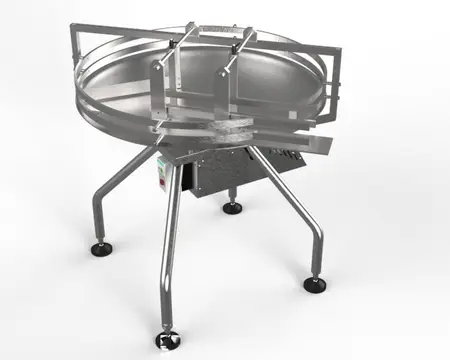
FEEDING TABLE
Designed for round packaging. With the optional alignment mechanism, it
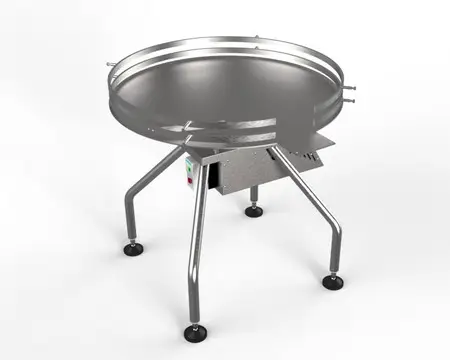
ACCUMULATION TABLE
Designed for various types of packaging. Capacity: Up to 4800
Jar Cleaning Machines
Jar Cleaning Machines: Your Brand’s Insurance Against Invisible Dangers
There is a common urban legend in the production world: “Jars already come clean from the factory, why clean them again?”
Let’s be honest; this mindset is the source of the greatest misfortunes that befall manufacturers. Those sparkling glass jars or plastic bottles arriving at your factory on pallets or in cardboard boxes actually carry microscopic (and sometimes visible) guests. Cardboard dust, particles sticking due to static electricity generated during transport, and even tiny glass shards remaining from production errors…
What happens if these “uninvited guests” meet your product on the filling line? The answer is simple: customer complaints, product returns, and worst of all, a shattered brand image.
As Kulp Makine, we believe that cleaning is not just about “removing visible dirt.” Jar Cleaning Machines are the invisible shield of your production line. This technology, which makes the interior of the packaging 100% safe just before your product enters the jar, is the most concrete proof of the respect you have for your customers.
Why “Air Rinsing” Instead of Washing?
In traditional methods, jars are washed with water. However, water means drying tunnels, extra energy costs, wastewater management, and most importantly, the risk of moisture. Especially in the food and pharmaceutical sectors, moisture remaining inside the jar can invite bacterial growth.
This is why we prefer Air Rinsing technology in modern production lines.
How the System Works (Let’s Explain Simply)
Although these machines may seem complex, they are actually a perfect dance of gravity and aerodynamics.
Inverting: Jars coming from the conveyor are turned upside down by a special tunnel (twist) or a gripper mechanism.
Air Shock: While the jar is inverted, high-pressure, filtered clean air (or ionized air if requested) is sprayed into it. This air shock dislodges stubborn dust and particles stuck to the bottom and sides of the jar.
Vacuum Extraction: The airborne dust is sucked in and removed from the line by a powerful vacuum system operating simultaneously.
Finalizing: The perfectly clean jar is turned upright again and continues its journey toward the filling machine.
All of this happens in seconds, untouched by human hands and without using a drop of water.
Kulp Makine Difference: The 316L Standard in Hygiene
When buying a machine, you might say, “as long as it does the job, it’s enough.” However, if you are producing food, cosmetics, or pharmaceuticals, the material of the machine is vital. Kulp Makine’s jar cleaning units are manufactured using AISI 304 and 316L Stainless Steel, the gold standard of the industry.
Why are we so persistent? Because stainless steel does not harbor bacteria, does not corrode, and is the easiest material to clean. Furthermore, the air filters we use in our systems guarantee that the air entering the jar is dry, clean, and free from ambient dust. In our view, there is no room for a mistake like “using dirty air to clean.”
For Which Products Is It a “Must-Have”?
While it is necessary for every packaged product, in certain sectors, it is a necessity rather than a preference.
Baby Food: Could you risk the presence of a glass shard in a product a baby will consume? Never. These machines minimize glass packaging risks.
Honey and Jam: In sticky products, even the smallest speck of dust inside the jar ruins the product’s clarity; it glitters in the sunlight and says, “I’m here.”
Pharmaceuticals and Supplements: In this field where hygiene standards are highest, static dusting is unacceptable.
Cosmetics: You wouldn’t want to see a black speck when you open the lid of a luxury face cream, would you?
Integration into Your Production Line: Cleaning Without Slowing Down
One of the biggest concerns for manufacturers is: “Will adding another machine slow down my line?” Kulp Makine’s cleaning systems are designed to operate synchronously with the speed (capacity) of your existing production line.
Linear Systems: Ideal for low and medium capacities.
Rotary Systems: Suitable for high-speed lines.
The machine works as a natural part of the line. If your filling machine fills 3,000 bottles per hour, your cleaning machine performs at that same speed. No slowdowns, no bottlenecks; just continuous hygiene.
The Cleaning Machine as a Reputation Investment
Sometimes, when chatting with business owners, we encounter the question: “Can we skip budgeting for this machine?” Our answer is always the same: This machine is your brand’s insurance policy.
Imagine you sold thousands of jars of product, and a foreign substance was found in just one of them. With the power of social media, it is only a matter of moments before this error reaches millions. The cost of recall operations and the damage to your brand reputation stay massive compared to the investment you make in this machine.
As Kulp Makine, we don’t just produce machines; we produce the confidence that allows you to put your head on your pillow peacefully at night.
Conclusion: Clean the Invisible, Build Trust
Quality is hidden in the details. Your customers may never know how the inside of the jar was cleaned. But when they see the same cleanliness and the same quality in every jar they open, their loyalty to your brand will increase.
Let’s eliminate those “invisible dangers” on your production line together. Contact us for the air rinsing solutions most suitable for your packaging type, production speed, and budget. A clean start is half of a perfect product.
Frequently Asked Questions (FAQ)
1. Can this machine clean glass shards?
Yes. Especially in our machines using the “twist” (inverting) method, gravity and pressurized air shock work together. Since the jar is upside down, glass shards or heavy particles are dislodged by air pressure and fall down by gravity to be extracted by vacuum.
2. Is air rinsing as effective as water washing?
It depends on the type of packaging and the state of contamination. For dust, cardboard fibers, and production residues in new packaging, air rinsing is the most effective and safest method because water creates drying issues. However, if you are using recycled bottles (returnables), then washing with water and chemicals may be necessary. Kulp Makine solutions are optimized for zero (new) packaging.
3. Dust sticks to plastic (PET) bottles due to static electricity; can the machine solve this?
Absolutely. Plastic bottles attract dust like a magnet due to static electricity. In these cases, we can add “anti-static” (ionizer) bars to the machine’s air nozzles. This system neutralizes the electricity, allowing the dust to separate from the surface.
4. Do I need to buy a separate machine for different-sized jars?
No. Our machines are flexible. The “twist” tunnels or grippers that hold or turn the jars are replaceable or adjustable. Changeovers to different formats (format change) can be performed by the operator in a short time.
5. Do I need an air compressor?
Yes, pressurized air is required for the system to operate. However, what matters is the quality of the air. The air coming from the compressor must be oil-free and moisture-free. The filters at the machine inlet support this, but it is important that your plumbing is also suitable.